How To Measure Your Foot at Home
Have you ever experienced the disappointment of buying shoes that didn’t fit? You’re not alone. We’ve all been there, whether it was an impulse online purchase or a gamble in-store. But don’t worry; there’s a solution. By learning how to measure your foot at home, and knowing your actual size, you can avoid future letdowns and save yourself the hassle of returns. Read on to learn how to measure your foot at home.
Discovering your foot size is essential for finding the perfect fit. Ordering your correct size increases your odds of a good fit across brands with sizing differences. There is a good chance you may be unknowingly wearing the wrong shoe size. Research suggests that up to 72% of individuals experience discomfort due to ill-fitting footwear. Discomfort or pain is often associated with the wrong shoe size. If you buy shoes online, you will benefit from knowing your actual shoe size.
Let’s dive into how to measure your foot at home to better navigate shoe size charts for women. This guide lets you quickly find your ideal fit and say goodbye to uncomfortable shoe break-in periods.
You’ll need two simple measurements: foot length and foot width. A flat ruler, a measuring tape, and a wall are all you need. It is essential to measure both feet, as they may differ in size. One foot is likely larger than the other one, so go for the larger size to ensure ultimate comfort.
Editor’s Note: Our How To Measure Your Foot at Home Guide was last updated on March 3, 2024.
How to Measure the Length of your Foot with a Ruler or tape Measure
- 1: Place a ruler or tape measure flat on the floor, with the lowest number touching the wall. You can use a tape measure as well.
- 2: Position your heel against the wall, pointing your toes forward. Ensure your heel rests gently against the wall without applying too much pressure.
- 3: Measure the distance from the wall to the tip of your longest toe, usually your big toe or second toe. If your feet are longer than a standard 12-inch ruler, use a measuring tape and pull it straight.
- 4: Jot down this measurement.
Whether you measure your foot in cm or inches does not matter, as our shoe size calculator offers both options.
How To Measure the Width of Your Foot at Home
Now that you’ve determined your foot length let’s learn how to measure your foot width. Ensuring a comfortable and well-fitting shoe requires an accurate measurement of the widest part of your foot.
Follow these simple steps to get the perfect width measurement:
- 1: Place the ruler or tape measure on the ground horizontally
- 2: Step onto the ruler or tape measure with the ball (widest) part of your foot.
- 3: Measure the distance from one side of your foot to the other in inches.
- 4: Jot down this vital number in cm or inches.
How to Measure the Length of Your Foot on Paper at Home
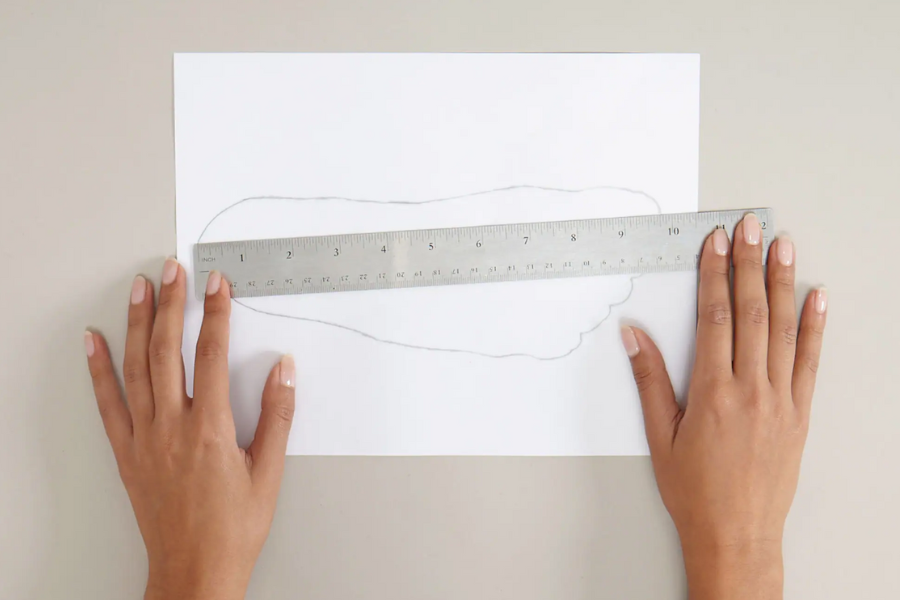
- 1. Place a sheet of paper on the ground. Step onto the middle of the sheet of paper. Find your center by standing tall and steady on both feet.
- 2. Trace a line around your foot. It’s best to get a friend to do the tracing. Although you can do it yourself, it may result in a slightly less accurate outcome. Measure both feet.
- 3: Using a tape measure or ruler, measure your traced footprint’s maximum length and width. To get an accurate measurement, measure the width of your feet in a straight line parallel to the edge of the paper. You can measure in inches or cm, as most size charts convert both.
Avoid measuring diagonally, as it can distort the result and make your feet appear wider or longer than they are. Your feet will likely be different lengths and wides. Use the larger of the two measurements.
Measure your feet in the evening for the most accurate results. As the day goes on, your feet naturally swell, so it’s the best time to get a proper measurement.
Now you have the precise measurements to buy shoes with the best chance of fitting you. Your foot length determines your shoe size, while the width measurement tells whether you need narrow, medium, or wide shoes.
Size chart comparison
How To Know Your Shoes Fit Well
When you’re in the market for new shoes, the first and foremost thing to prioritize is their comfort level. While it’s natural for some shoes or boots to feel less cozy than others, like high heels, compared to walking shoes, they must never cause any pain or persistent discomfort.
Heel fit
The heel should feel snug and secure, with no uncomfortable tightness or annoying slipping. It’s essential for both circulation and preventing blisters.
For women with foot conditions like plantar fasciitis or bunions, look for a shoe with a heel cup with a firm shell. This structure will help with side-to-side control when walking. The control will also help prevent the foot from rolling in excessively or pronating.
Arch support
Wearing shoes with arch support alleviates the pressure in the foot’s arch and helps redistribute pressure so the body is better aligned. Women with some foot conditions need arch support for the overall health of their feet, alignment, and comfort. Many women can’t wear a shoe without arch support.
Not all women, however, need arch support in their shoes. Some are perfectly comfortable without it. But for those women who spend all day on their feet, having arch support is the key to being comfortable.
Toe Box
Wiggle room for your toes is crucial. You don’t want them cramped or squeezed; you want a manageable space. Finding the perfect fit for your toes will create a pleasant walking experience and maximize your overall comfort. So, ensure your toes can move freely without unnecessary pressure or discomfort.
Foot width
Your shoes should comfortably hug your feet without squeezing. Try wide or narrow widths if they feel too tight or loose on the sides. Many women with wide feet often don’t realize it. Instead, they buy shoes a half size up and tighten them with buckles or laces to compensate. Sizing up is not a good strategy because, for the optimum fit, the shoe must accommodate all areas of your foot.
Instep height
If you have a high instep, your foot tends to have more volume and requires more space inside your shoe. Having a low instep means you have less volume and require less space. It is crucial to discover patterns that can accommodate your insteps. Generally, shoes with adjustable straps or buckles are the most suitable. Another great choice is ballet flats, which naturally fit low on the instep and can accommodate different instep levels.
How To Buy Shoes On Line That Fit
When finding the best fit for your shoes, it’s important to remember that different types of shoes may require you to go up or down in size. Let’s take running shoes, for example.
Running Shoes
For optimal comfort and support in a running shoe, consider going up half a size to give your toes ample room to handle the momentum and impact. This strategy will give your toes a little extra wiggle room.
Leather Shoes
Also, remember that some shoes, particularly leather ones, may stretch and conform to your feet over time. Some shoes and boots only come in whole sizes or medium widths. So, if you encounter a pair like this, consider this as well.
Shoe size variations
When shopping for shoes, it’s important to remember that different brands may have slightly different fits. Some brands may run large, small, or made with European lasts.
To avoid confusion, always check the recommendations and reviews the brand provides. They will usually guide you on whether to size up or down and by how much. Reviewing the brand’s shoe sizing chart to double-check your measurements is also a good idea. Studying these will ensure the best chance of a good fit every time.
Conclusion
Finding your proper shoe size is essential when buying casual, comfortable footwear. Now that you know how to measure your foot at home, you have a better chance of finding the most comfortable and supportive shoes the first time. So, follow the tips outlined above and check out sizing charts and reviews before purchasing. If in-between sizes, always err on the side of caution and size up. With these simple steps, you will have the best chance of getting the best fit every time. Happy shopping!
You might also be interested in these guides written by our shoe experts:
Suede Care
Leather Care
Can Leather Get Wet?
Stretching Leather